

Note: this is the second post in a 5-part blog series about the relationship between Oracle and AI, specifically in the EPM space.

EPM and AI? What? Have EPM robots arrived to take over our jobs already?
No, and that is not slated to happen ever, as far as I’m concerned. Although it sounds like AI has exploded everywhere only recently, the truth is the merger of Oracle EPM and AI is not a new concept. AI has been in Oracle Cloud EPM applications for years. It may not have been something you were paying attention to before, but “AI” has become an everyday word. In fact, “AI” was one of the fastest growing words in 2023.
AI made its debut appearance in EPM through the Planning Cloud feature known as Predictive Planning years ago. Since that time, the Oracle EPM team has been improving and expanding the use of AI.

Where else does AI exist in the Oracle EPM application world? And what can we expect to see in the future?
I reached out to Marc Seewald, Oracle EPM Product Manager and one of my long-time EPM peers, to find out more. Marc has presented on IPM more than any other Oracle EPM Product Manager. He’s very passionate about the technology and how it can enable customers to do more with Oracle Cloud EPM.
But first, a terminology lesson…
The first thing we discussed was the abundant terminology for AI used by Oracle, the industry, and tech in general. It can be confusing and it was quickly becoming clear the terminology is not consistent across the Oracle ecosphere.
As Marc explained, the Oracle EPM Product Management team uses the term “IPM” or Intelligent Performance Management to refer to this type of leading-edge technology.
But what is IPM? And does IPM only mean Planning?
IPM is an umbrella term for all investments in AI (artificial intelligence), ML (machine learning), and data science within the realm of Oracle EPM.
And no, it doesn’t include only Planning apps within the Oracle Cloud EPM solution stack. Although the term “IPM” started in the Planning domain, it has already branched out to other apps.
What is Oracle EPM’s general vision for AI?
The Oracle EPM team’s perspective on AI in EPM is quite simple. They’re building predictive and other AI capabilities within the context of Finance. What this means is they’ll be leveraging AI to help EPM users be more productive and gather better insights from their EPM data. They want to optimize the time and effort of EPM users…and without the usual extensive technical training required for this type of advanced technology.
Most folks who use AI today have software engineering or data science backgrounds. Oracle wants to bring this leading-edge technology to the Finance and Operational masses without the prerequisite of a PhD in data science.
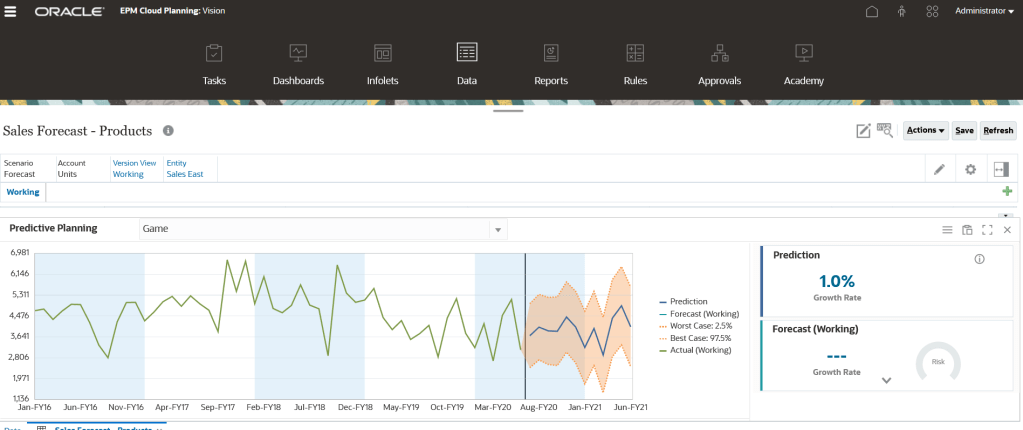
How do you see this technology playing a role in the day-to-day life of an Oracle EPM user?
IPM is designed to give users a tool to help them be more efficient and more effective. Even tasks like data analysis are still largely manual – and AI can help humans do this faster and more effectively. Instead of trying to remove humans from the equation, the goal of AI would be to make its EPM users “superhuman.”
In addition, IPM is mostly in the Planning domain today. However, it’s joining Financial Consolidation & Close and Profitability & Cost Management soon, and is being expanded in the EPM reporting realm.
How quickly can Oracle adapt and evolve to AI changes in the marketplace?
Oracle has an advantage in this space, as they’re both an apps and technology company. Many of Oracle’s competitors have to use a 3rd party AI tool to accomplish the same functionality.
With Oracle it’s different. The AI is developed in-house. That allows for more cross-division collaboration, creativity, and innovation. (Note: I’m already seeing evidence of this through my interviews for this blog series).
Oracle can also leverage economies of scale because they made these investments early and can take advantage of them now. You won’t see Oracle charging an extra $100K for an AI add-on, like some of its competitors. The feature just shows up as a new innovation in Oracle Cloud EPM environments.
How does Oracle EPM’s vision of AI compare to your competitors?
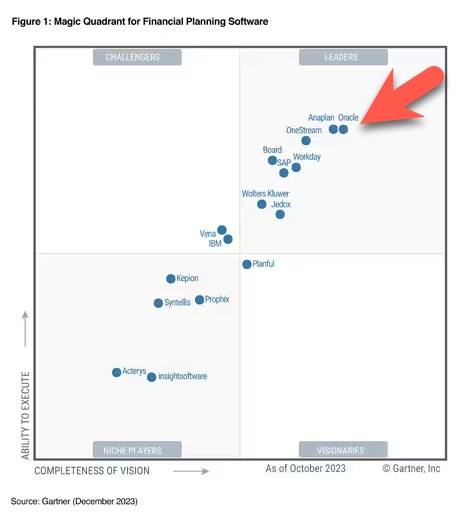

Oracle EPM apps have been leaders in the Gartner Magic Quadrants for many years, and they were again most recently in December 2022 and December 2023. The IPM capabilities were specifically called out for Gartner’s Visionary measurement.
Marc stated that every vendor is now talking about AI, and Oracle competitors are choosing to include it in their technology using a 3rd party approach.
The Oracle EPM team is differentiating their AI approach in 3 ways:
First, Oracle’s building it directly into their EPM platform, versus integrations with 3rd parties. This makes it cheaper to use since no additional costs are required to add on another vendor.
Second, Oracle’s focusing on making adoption easy for Finance and Operational users by building it into EPM processes, as opposed to just providing a raw AI engine. As mentioned before, you don’t have to have a data science background to learn and use these cutting-edge features.
Finally, Oracle provides greater “explainability” to predictions – thereby building trust for users. The #2 trend in the December 2023 Gartner’s Magic Quadrant report was transparency, which is critical with a tool like AI. Customers need numbers and insights to be explained. They also want accuracy. Oracle provides both with IPM and continues to improve upon this feature.

What stage of adoption is IPM in with Oracle EPM customers and partners?
I was astounded when Marc revealed that Oracle already has hundreds of customers using IPM in Production today. While this is not the majority, what this does mean is Oracle is no longer in the early stages of adoption.
As Marc stated, with the emergence of ChatGPT and other GenAI technologies, AI has strong inertia. Customers are curious about what it can do for them. General Dynamics, an active customer of the AI tools within Oracle Cloud EPM, presented on it at Oracle Cloud World 2023.
What barriers are you seeing with IPM in the EPM space?
The top barrier their team has noticed is customers and partners not knowing where to start. Through their team’s experiences, it’s clear Finance is universally intrigued by this technology. But customers are also feeling overwhelmed.
Marc emphasized IPM is not hard to learn…and it’s not rocket science. He believes it takes just a couple of weeks of playing with it in your free time. Then you can roll it out.
What is the most prevalent use case the Oracle EPM team is seeing for IPM?
This was an easy answer. The top use case is within the Planning domain and it’s using predictions to validate a forecast.
I wasn’t surprised to hear this – it’s the most straight-forward way to use this technology in Planning apps. Trust is still a factor with AI and customers would want to understand how the tech works before attempting to use it in a formalized way.
Marc went on to state that customers are not replacing their forecasts with what AI generates, but validating them. This strategy uses a combination of IPM predictions and insights.
There are still trust factors out there with AI. What happens to the IPM customer data within a customer’s Cloud EPM instance?

“Oracle takes customer data security very seriously,” Marc began. He went on to explain that because of the way Oracle has embedded the AI technology within the Cloud platform, Oracle EPM customers don’t have to be concerned about the additional risk of data being sent/stored within a third-party tool. “The data never needs to leave Oracle.”
In addition, as Oracle has been saying since the advent of Cloud EPM, individual customer data is not intermingled with any other customer data. “Customers should feel rest assured their data is secure.”
What advice would you give to customers and partners who want to get started with IPM?
The first thing he recommended is for Planning customers to go to Cloud Customer Connect and watch the webinar on turning on Predictions (direct link shared at the bottom of this post). This gives the most comprehensive step-by-step instruction to this feature. “Work with predictions first, then move onto insights.” If a customer is struggling with predictions (especially accuracy, which can happen if you’re not familiar with the different settings), Marc said to log a bug and his team will get involved.
Marc believes the learning curve isn’t as steep as customers believe. While customers may not know where to get started, it’s not hard to learn this technology. “It’s just a matter of turning it on and iterating the settings.”
To prove his point, at the General Dynamics session at this past Oracle Cloud World, Marc asked if anyone on the team was a data scientist. None of them raised their hands – they were all Finance users.
Only when customers get into more complex predictions do the nuances settle in and more knowledge is required. I asked if features were coming that might help customers navigate the various settings. “Potentially a wizard [interface].”
What upcoming IPM features are you most excited about?
Marc first mentioned multivariant predictions. They’re coming out in the next 6 months (#safeharbor). To be honest, this is the feature I’m most excited about as well. It will allow customers to use multiple variables to impact a single prediction outcome.
Marc is also excited about operational modeling, which he said will have some degree of prediction. That’s also slated for the next 6 months.
Finally, he would like to see the incorporation of more GenAI (i.e. narrative, insights, etc.) in the solution platform. But we’ll touch on that topic more with the EPM Reporting blog post that I have scheduled for later in this series. 😉
A PSA to Oracle EPM partners
I was pleasantly surprised by the attention from my first blog post in this series. Feedback was positive, fueled by excitement, and generally inquisitive. And those conversations revealed something critical that I think is worth sharing.
10 years ago, the EPM world was disrupted by Cloud. A quick history in case anyone’s forgotten: EPM Cloud debuted on Valentine’s Day 2014 with Planning Cloud (PBCS). Since then, Oracle has seen explosive growth with their Cloud platforms. All of my EPM customers are on Cloud. I haven’t touched or seen on-prem Hyperion for nearly a decade now.
Although the EPM world is slow to change, Cloud started making sense and customers got on board. Cloud was a disruptor to our industry.
And now, whether you acknowledge it or not, another disruptor has entered our EPM world: AI. Vendors, customers, and partners alike are all talking about it. With any new technology comes trepidation. However, like with Cloud, the tide is turning and customers are starting to inquire more about it. The capabilities are there. And they will get better as AI continues to move ahead at the speed of light.
Therefore, if you’re not on board with AI, you’re becoming outpaced by your competitors. On LinkedIn, I’m already seeing EPM consulting firms creating divisions just for AI technology.
Don’t be left behind. Start learning more about AI and what it can do for you and your customers. Oracle has invested heavily in this technology and it will provide more and bigger capabilities, and in a safe way for EPM customers. At the end of each post in this series, I’ve included resources for how you can learn more.
In the next post in this series, I’ll do an introduction of Oracle + AI in the Analytics world.
A big shout out to Marc and the Oracle EPM team for always being available to customers and partners.
Resources
Curious about Oracle’s AI as it exists within EPM? Here are some links to help get you started:
- Oracle’s page about Gartner’s 2023 Magic Quadrant winners for Financial Close: https://www.oracle.com/performance-management/gartner-financial-close-magic-quadrant/#form
- Oracle’s page about Gartner’s 2023 Magic Quadrant winners for Planning: https://www.oracle.com/performance-management/gartner-financial-planning-magic-quadrant/#form
- Marc’s recommended Cloud Customer Connect webinar for getting started with Predictive Planning (requires a login to CCC): https://community.oracle.com/customerconnect/events/604835-epm-best-practices-in-predictive-planning-with-oracle-cloud-epm
- The link to Oracle’s IPM tutorials page: https://docs.oracle.com/en/cloud/saas/planning-budgeting-cloud/tutorials.html
The Full Oracle+AI Blog Series
Did you miss a post? Here is the YTD list of posts in this Oracle + AI blog series:
- Oracle + AI Series: My Superhero Avatar
- Oracle + AI Series: Continuous Innovation with EPM Apps (this one)
- Oracle + AI Series: Analytics + AI = A Data-Driven Marriage
- Oracle + AI Series: Next Gen Oracle EPM Reporting
- Oracle + AI Series: Revitalizing Your Oracle EPM Career with Personal GenAI
- Surprise bonus post! Oracle + AI Series: GenAI in the Wild
 woman in epm
4 thoughts on “Oracle + AI Series: EPM Apps – Continuous Innovation”