

Note: this is the third post in a 5-part blog series about the relationship between Oracle and AI, specifically in the EPM space.

After talking to several folks already about the collision between AI and Oracle technologies, there was a clear next step. I was told to look at the Analytics team, as much innovation with AI was happening in that space. Luckily, I have a few friends there and reached out for an interview.
My buddy and Analytics product manager Mike Durran put me in touch with Philippe Lions, who you may have seen speak at conferences like ODTUG Kscope and Oracle Cloud World. Philippe is one of multiple product managers who focus on the integration of Analytics with AI. He and the entire Analytics team are very excited about what they’re currently innovating and what’s ahead for customers.
But first, a terminology lesson…
It was immediately clear that I had to a reset on terminology once Philippe and I got started. “AI” (artificial intelligence) is not an umbrella term in the Oracle Analytics space. It represents part of this type of tech. The Analytics team distinguishes between AI, ML (machine learning), and NLP (natural language processing) and even has variations of the term, like “Augmented AI” (a blend of AI and ML).
Why? The Analytics team speaks to a variety of users, including business users with zero background in data science and related skills, to highly capable users who understand the technology very well and want to pick and choose between the different features and experiences. For instance, if you’re a business user with no technical background in this space, you may want to opt for the Augmented AI experience, which allows you to be proactive with your data with minimal risk and no coding. But if you’re an experienced data science person, you might know exactly what you’re looking for and choose to play with a different experience geared for your end goal.
Wait…what is “OCI AI Services”?
One of the points I found to be confusing when doing my pre-interview research was something called “OCI AI Services” which the Oracle Analytics site mentions. OCI AI Services offers additional AI services like:
- Chatbots (“virtual assistants”)
- Text analysis
- Speech and image recognition
- Data extraction services
- Anomaly detection
But was it a costed add-on service or part of the Analytics platform? Philippe clarified OCI AI Services was already part of the Analytics solution. This is all integrated into the Oracle Cloud platform. Wow. He shared the following Oracle slide to give a better picture of how this all fits together:
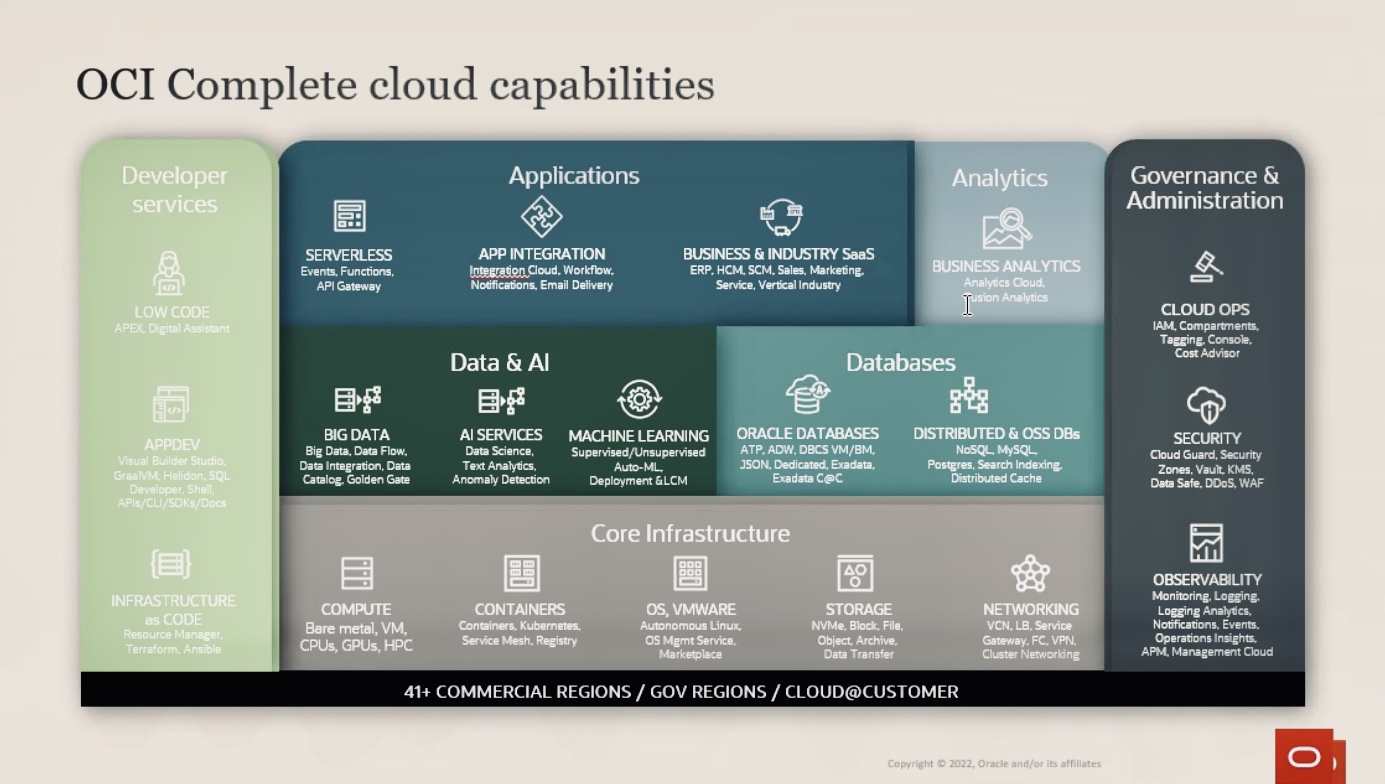
He then went onto explain how pricing works in the Oracle Analytics space. Analytics charges customers differently from SaaS, which includes subscription services like EPM. The Analytics platform is consumption-based, more like a utilities company. So, while so many of these features are available in the Analytics platform and there is no direct add-on charge, you’ll see the charges via the “utilities” services you use with Analytics.
A quick summary of the AI capabilities within the Analytics platform
For those of you who are more focused on the EPM side of the Oracle house and haven’t looked at your stepbrother, Analytics, you may need a quick refresher on what’s going on in that world. It’s been a minute since I’ve been involved with the Analytics team. I needed a review.
Philippe volunteered to give a quick recap of what they’ve been working on with AI. The following slide is used in many presentations to summarize the evolving capabilities of this leading-edge tech in Analytics.
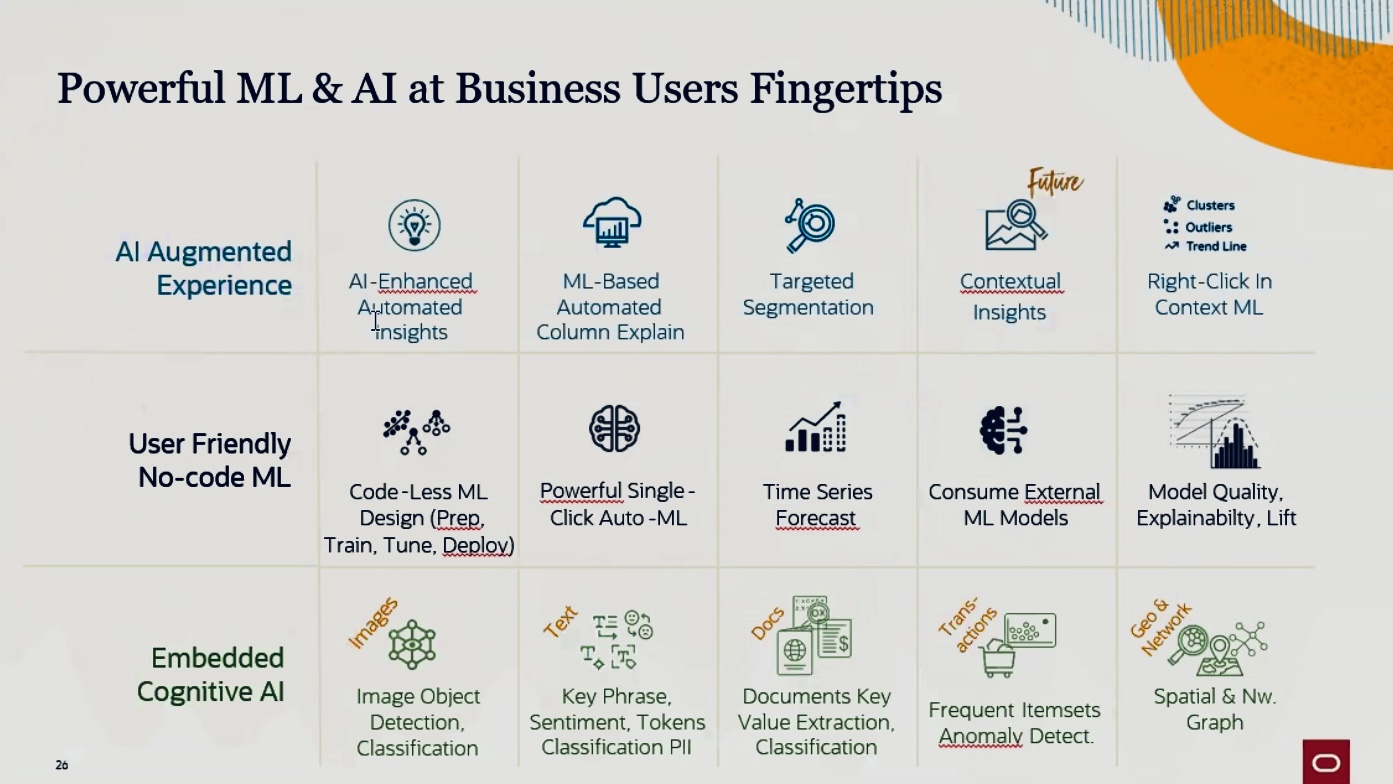
And here are the contextual bullet points:
- AI Augmented Experience: created with the end user in mind—these are features that give the user proactive insights about their data, in various forms. For example, as you load up your data in Oracle Analytics, it will automatically be introspected. Meaningful insights will proactively be presented to you as you start building new visualizations. This is the Auto Insights capability of Oracle Analytics.
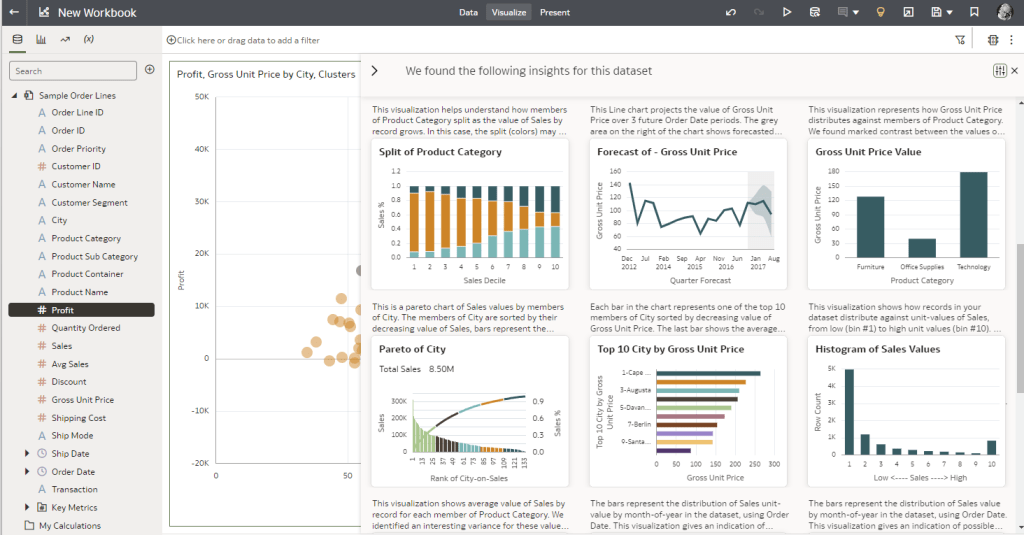
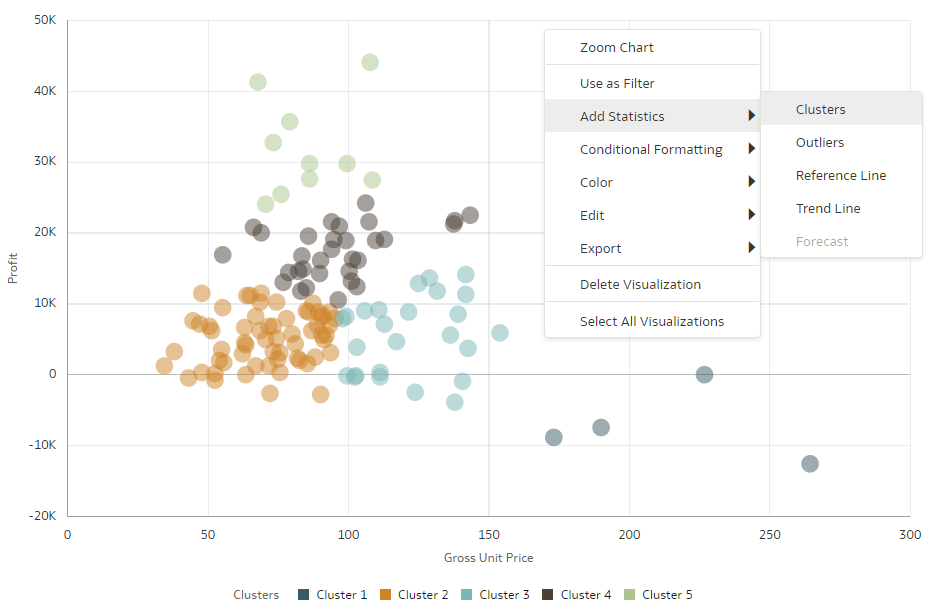
Another example is the single click capability to spot meaningful clusters or outliers directly in your visualization data.
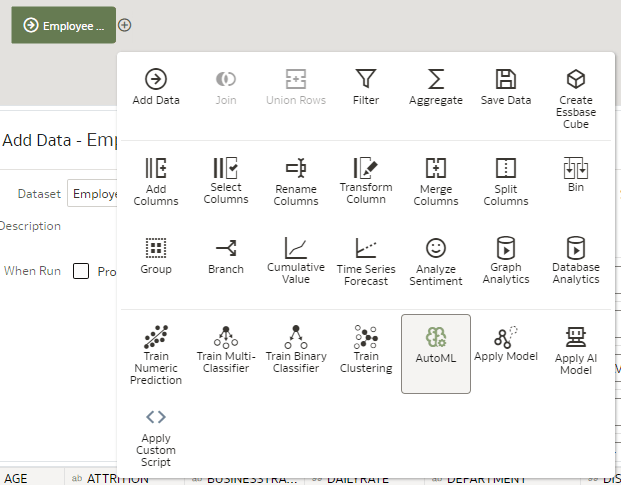
- User Friendly No-code ML: also created for business users with no technical background, this feature has a user interface (“UI”) in Oracle Analytics that allows users to design and apply regressions, forecasts, classifications, etc. The “Auto ML” capability allows a user to tell the platform what they want to predict and it will return with an optimal model to deliver their prediction request:
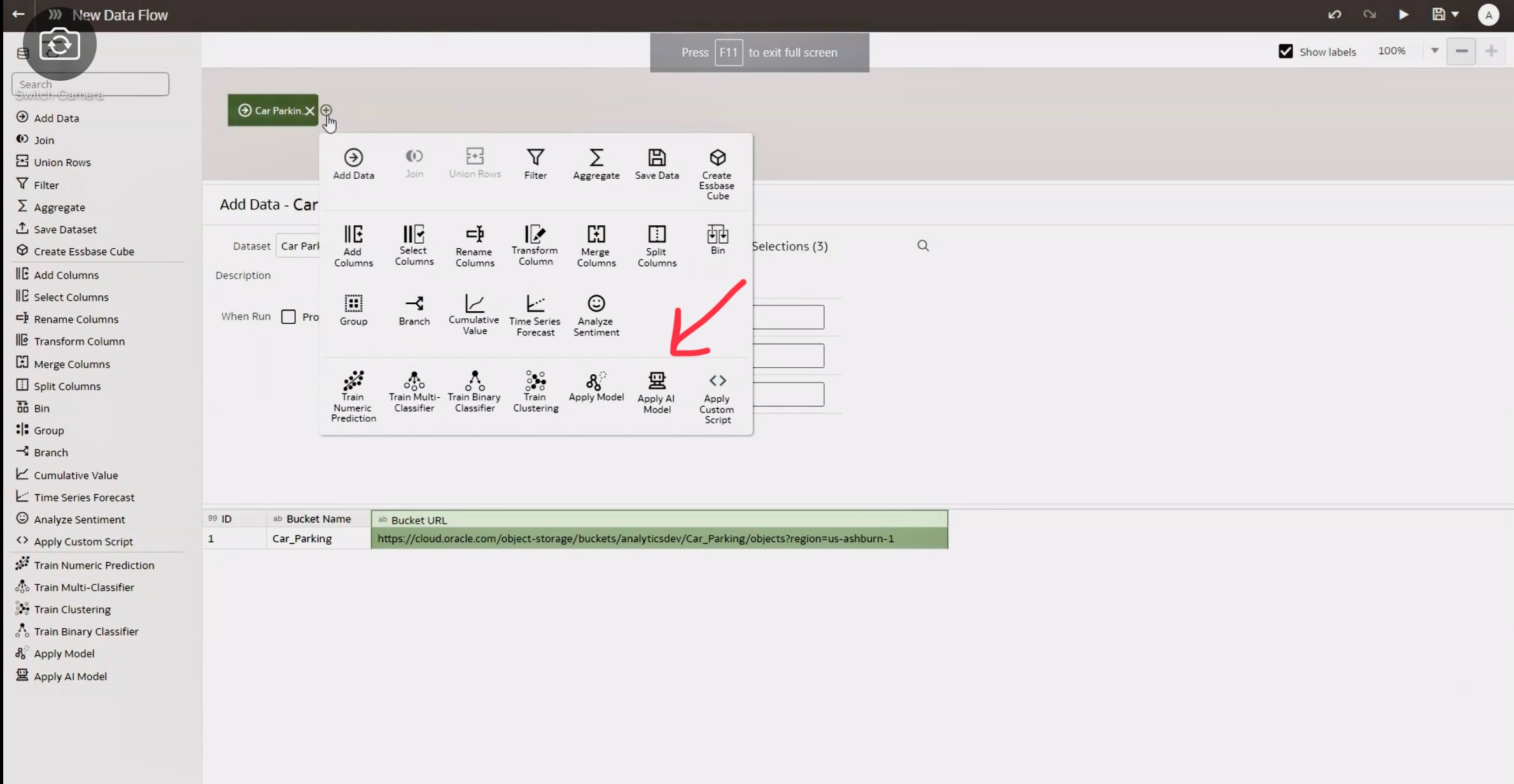
- Embedded Cognitive AI: advanced AI in an easy and fun way with no ML training necessary. And you apply AI to your data flows in Oracle Analytics.
- Real-life example: Vision recognition. Oracle has a hospital partner using this now to review X-rays.
- Real-life example: another customer is using this with parking photos taken at a regular interval. The technology helps them figure out how many cars are in each parking lot at various times and days.
Who are some of your biggest customers using AI with Analytics?
We then talked about some of the informative real life case studies. In case you missed it, the Oracle Analytics team presented with two customers at the most recent Oracle Cloud World last fall: Outfront and Bowie State University.
Outfront

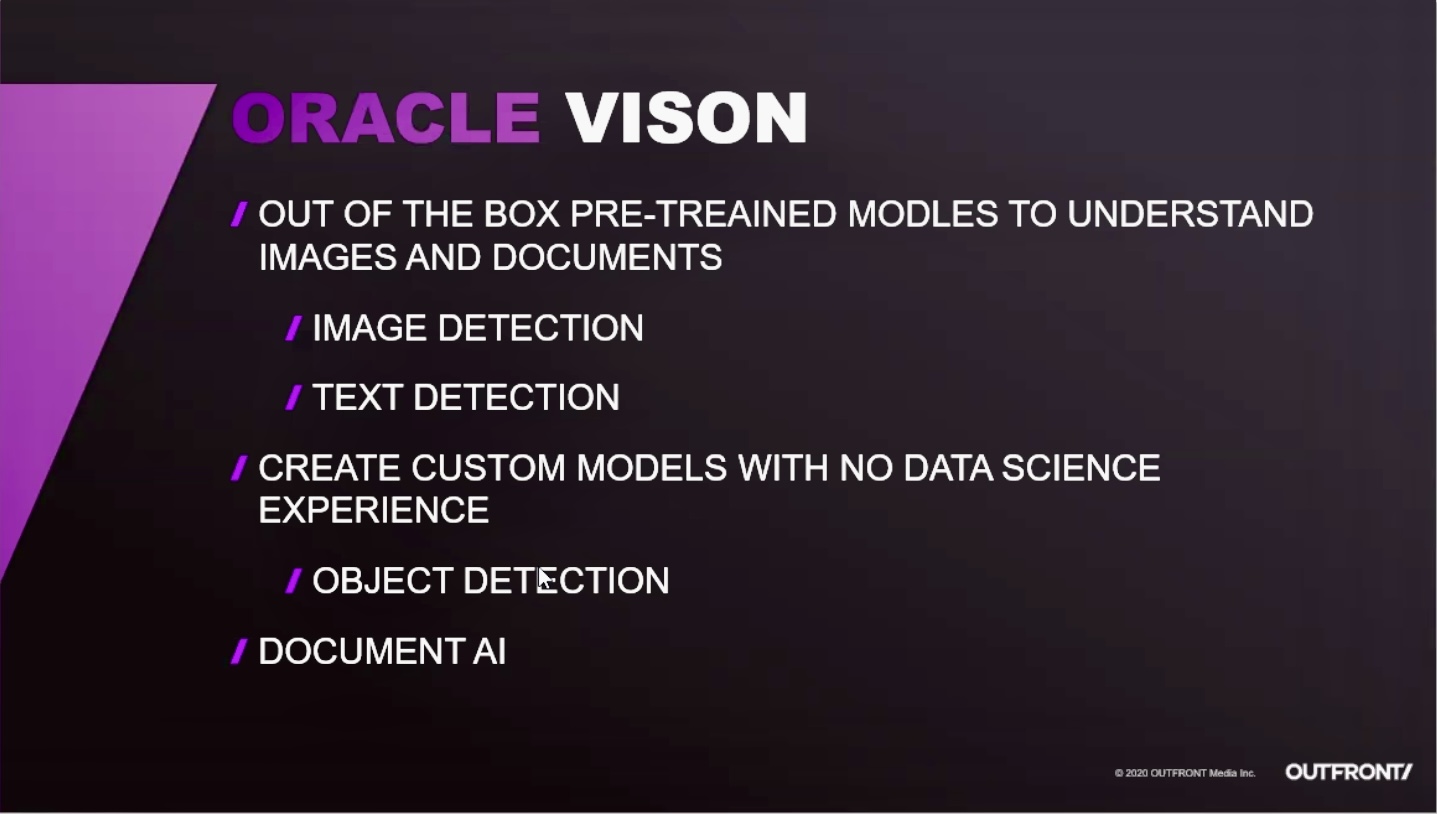
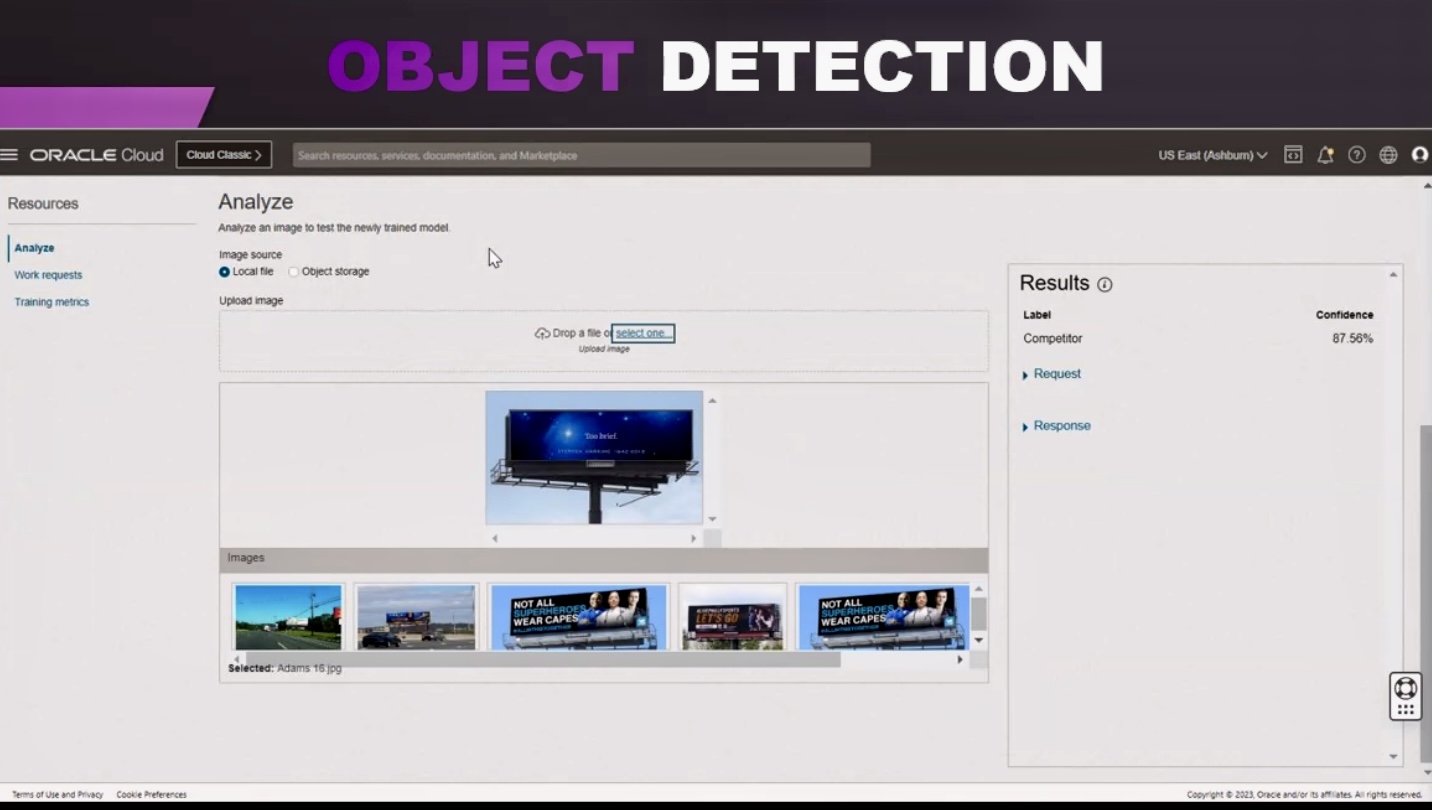
Outfront is in the business of advertising. You’d most likely see their name at the bottom of billboards as you’re zooming by on highways.
They’re using the auto insights feature and image detection. They use Oracle Analytics to examine billboard photos and gather information about the surrounding areas to penetrate the competition.
Bowie State University
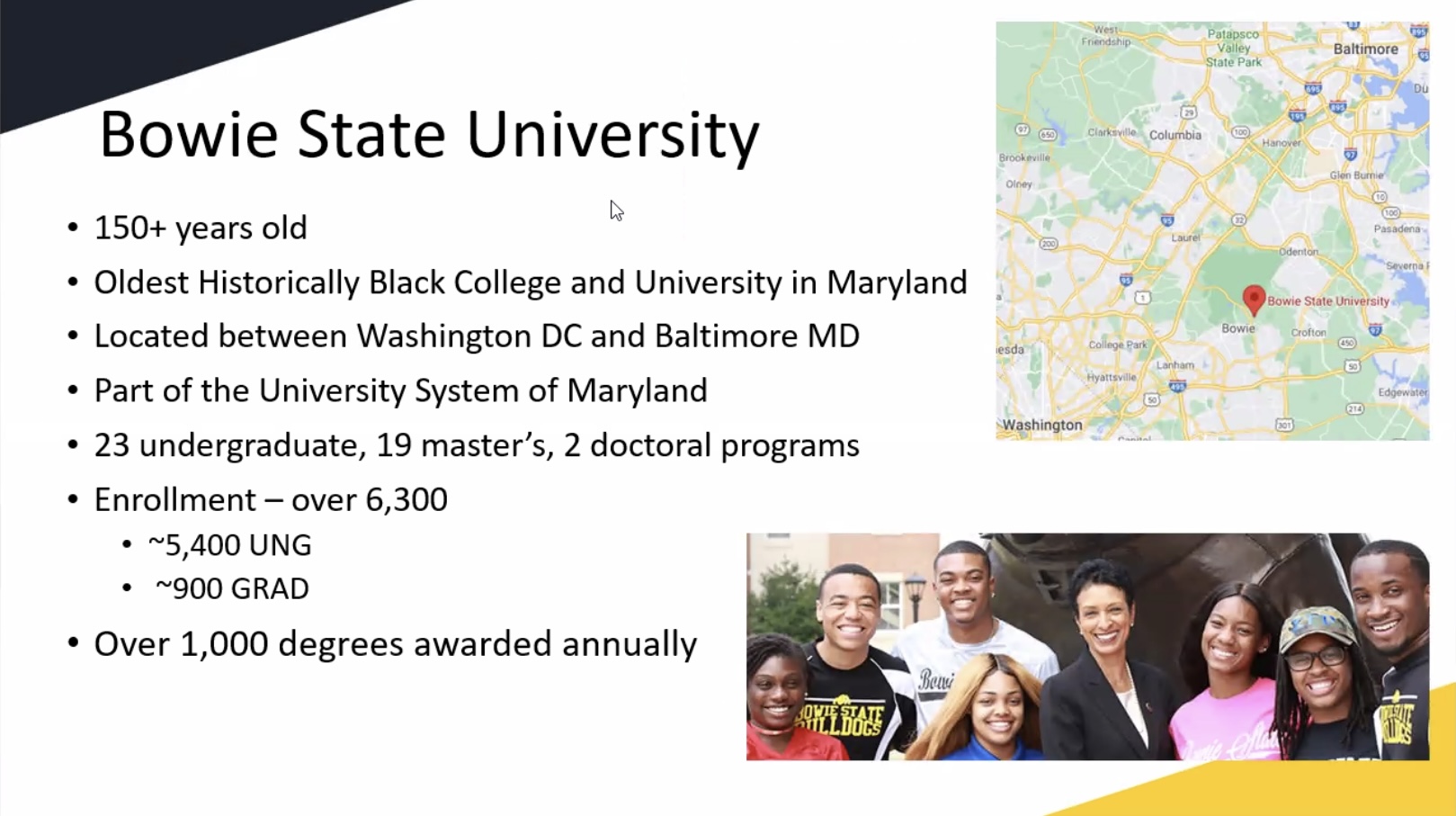
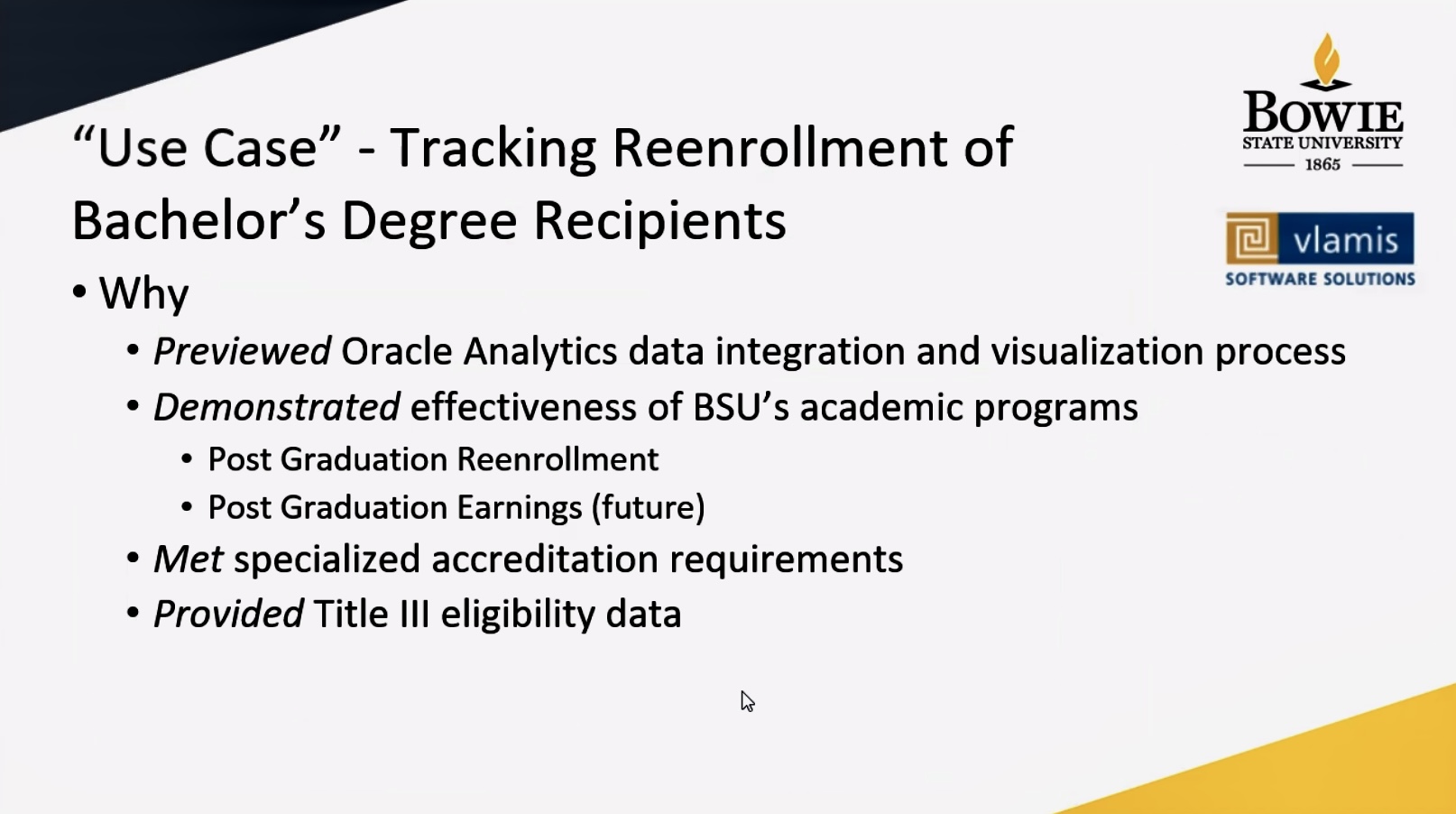
Bowie State University, a customer in higher education, is also actively using Oracle Analytics. As shown in the slides above, they use the technology to better measure enrollments.
What are the top use cases right now for AI in Analytics?
There are a few use cases Oracle Analytics customers are keen on.
The first one is Augmented AI. It allows customers to have insights in seconds without having to know anything about AI and Analytics. Users can easily dive into their data, understand key drivers, build powerful segmentations, or identify anomalies and immediately consumer these into their own dashboards.
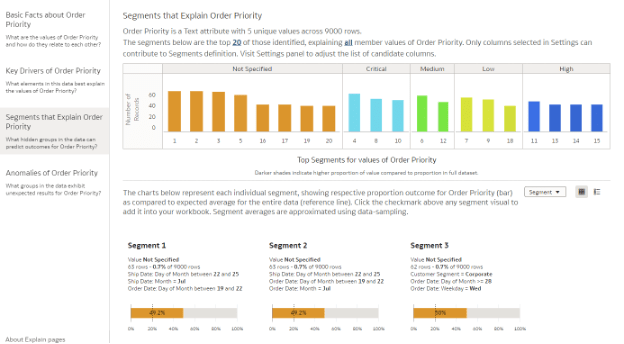
The second is Language AI, which interprets the sentimentalities in text reviews. Was the review positive or negative? This helps customers develop better products and services.
The third is Prediction, especially with time series forecasting. One specific example is an HR team using prediction with attrition and answering the question “What is the probability that this group of high-risk departure individuals will actually leave?” This uses an ML model with Auto ML.
How do EPM and Analytics overlap?
After thinking about what I learned, I noticed an overlap in the areas of AI and ML when it came to both EPM and Analytics. Personally, I find this to be the case often with many products within the Oracle ecosphere. As Philippe commented, “Oracle competing with Oracle is actually also generating value for our customers.”
Philippe believes that while Oracle Analytics and EPM both offer some aspects of ML technology, they are very complementary to each other. They each offer specific capabilities and domain context, especially with business users within the EPM application solution stack. “EPM today is using time series forecasting and is great at this,” he said.
It seemed obvious to me that EPM users wouldn’t replace EPM with Analytics but expand their existing AI and ML capabilities by addingAnalytics into their Oracle stack. I asked Philippe why he thought an EPM customer would do this. “Analytics augments [existing EPM] capabilities by allowing EPM users to go beyond time series forecasting by predicting other types of data”.
In my perspective, EPM is focused on the EPM use case and will be limited by those types of data sets. However, by adding Analytics, you’re purchasing a platform. Therefore, your data capabilities will become boundless.
What advice do you have for EPM customers and partners who want to get started with Analytics and AI/ML?
“In the context of the EPM business process, start by making the most of what’s offered with EPM directly. As you grow and refine your needs, expanding into deeper ML/AI with OAC will dramatically increase the business value you can extract on top of EPM,” he stated.
Interested in seeing what Oracle Analytics + AI/ML has to offer? I’ve included some resources at the end of this post that will help you get started.
What upcoming AI features are you most looking forward to?
Philippe is excited about the future of Oracle Analytics + AI/ML. He answered this question with “Copilot and Contextual Insights. These are both GenAI/Cognitive AI augmented features that will help consumer users derive powerful insights with no particular skills, in seconds.”
Additional Resources
- “ML for business users” YouTube video: https://m.youtube.com/watch?v=X3wsB95Xnkk&list=PL6gBNP-Fr8KUi73ZYNYptBssFnqxiS8Lo&index=27&pp=iAQB
- Oracle Analytics YouTube channel: https://m.youtube.com/@OracleAnalytics/videos
- Oracle Analytics website: https://www.oracle.com/business-analytics/analytics-platform/#rc30p5
- Oracle OCI AI Services website: https://www.oracle.com/artificial-intelligence/ai-services/
The Full Oracle+AI Blog Series
Did you miss a post? Here is the YTD list of posts in this Oracle + AI blog series:
- Oracle + AI Series: My Superhero Avatar
- Oracle + AI Series: Continuous Innovation with EPM Apps
- Oracle + AI Series: Analytics + AI = A Data-Driven Marriage (this one)
- Oracle + AI Series: Next Gen Oracle EPM Reporting
- Oracle + AI Series: Revitalizing Your Oracle EPM Career with Personal GenAI
- Surprise bonus post! Oracle + AI Series: GenAI in the Wild
 woman in epm
4 thoughts on “Oracle + AI Series: Analytics + AI = A Data-Driven Marriage”